
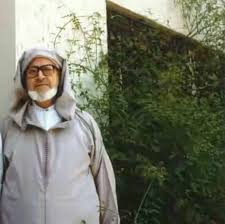
After answering a legal question about a traveler offering the Jumu’a sermon and prayer, Shaykh Idris al-‘Iraqi (God have mercy upon him) advised the reader to not be a “mashur-maximalist” in this age of dissolution:
And there is no harm in adopting a weak opinion—much less one that is practiced in the schools of the four Imams—especially in this age, wherein naught remains of Islam save its form, nor of faith save its name, as Ibn ‘Abbad said in his Letters. Thus spoke the verifying scholar, the knower of God, Abū ʿAbd Allāh, our master Muḥammad b. Aḥmad al-Kanṣūsī—may God be pleased with him—in a private letter he wrote to the knower of God, the noble master al-Sharīf ʿAbd al-Karīm, and his words are:
Know, O brother—may God reform our inner selves and yours through righteous intentions, and adorn our outward selves with acceptable acts of obedience—that the rightly guided believer should not constrain himself in these times; for if he were to do so, he would find neither a way out nor a helper, due to the corruption of the age and the majority of its people. Rather, what is incumbent upon a man today is: if he finds in a given matter a lawful way, or an opinion of one of the imams who are to be followed—even if it be weak—he should rely upon it, and that shall suffice him as a proof before God Most High.
And that over which you scruple—there is no cause for scruple in it, for the imams received it with acceptance, and it was acted upon in the cities and all regions without objection. And that suffices, God willing—especially given the intensity of the need for it. And you know that necessities permit prohibitions, such as eating carrion in starvation, or swallowing a morsel with wine when choked.
This is the very age of which Sufyān al-Thawrī—may God be pleased with him—spoke, when he said: Do not seek, in the latter days, what is lawful without doubt, lest you die of hunger. Do not seek a scholar who acts upon his knowledge, lest you remain ignorant. Do not seek a companion without flaw, lest you be left companionless. Do not seek a deed devoid of ostentation, lest you be left without any deed at all.
These four, then, should not be sought in this age. And whosoever seeks to manifest in this time what God has not manifested in it—he has left no portion of ignorance behind him.
~Shaykh Idris al-‘Iraqi, Majmu’ Rasa’il Fiqhiyya (unpublished)

 Tijaniyat
Leave a comment