
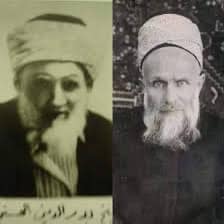
The Imam of the Syrian lands, master of spiritual, scholarly, and armed revolutions that shook the entire region, as noted by the Syrian writer and historian Shaykh ‘Ali al-Tantawi, reached a level of fame and prominence unmatched by his contemporaries or those who came after him. His influence and goodness spread throughout all the Syrian provinces, reaching deep into the Hawran, and into Turkish and Kurdish regions. You can scarcely find a righteous person or scholar in any of those lands except that Sidi ‘Ali Daqar has a debt upon his neck. Specialists even stated that such universal impact did not occur for his teacher, the great Imam, Sidi Badr al-Din al-Hasani.
He studied under the great masters of his time and spent lengthy periods with the learned Imam, Shaykh Muhammad al-Qasimi—known for his Salafi inclinations. Qasimi was strongly committed to enjoining the good and forbidding the evil, stern in his commitment. Because of his sternness the Najdi sect [the Wahhabis] and their followers attempted to claim him as their own, as one belonging to their newly invented doctrine, though our Shaykh al-Qasimi was innocent of it. He was the chief authority of the Shafi‘i school in the Syrian lands. It was from him that Sidi ‘Ali Daqar inherited this characteristic; thus Allah revived the school through him after a period of decline due to the dominance of the Hanafis in Damascus.
He also inherited from him the trait of firmness against reprehensible innovations and deviations. Shaykh ‘Ali Daqar and his students—during his life and after—were among the strongest of people in confronting reprehensible religious innovations. Some of his students even publicly warned and disciplined wrongdoers in the streets and marketplaces. He also studied under the renowned legal theorist and Sufi master, Shaykh Amin Suwayd, benefiting from him greatly.
He remained long in the company of the hadith master of Sham, Sidi Badr al-Din al-Hasani, and was the dearest of his students. Sidi Badr al-Din never ceased praising, honoring, and magnifying him whenever he was mentioned, even after the immense trial that befell him—a tribulation the like of which Sham had never seen. Everyone united against him and against the path he adhered to and transmitted—namely, the exalted Tijani Tariqa.
The fire of this trial was fueled not only by the leaders of the deviant “Salafi” school such as Kamil al-Qassab, Rashid Rida, and Muhibb al-Din al-Khatib, but it was led and further inflamed by the grandson of Emir ‘Abd al-Qadir al-Jaza’iri, known as Emir Khalid.[1] Added to them were the students of Shaykh Muhammad al-Khidr al-Shinqiti, who brought his criticisms and attacks on the Tariqa to the Syrian regions. Added also were those driven by personal interests and jealousies among the adherents of various paths—whose hearts were filled with envy toward our Shaykh Daqar due to the acceptance Allah granted him, his students, and all associated with him throughout Greater Syria.
Thus, our Shaykh ‘Ali Daqar, together with his senior deputies, students, and members of his noble association—out of compliance with Divine Will—concealed the outward forms of the Tariqa, refraining from spreading them except to the select few.
Imam Badr al-Din al-Hasani said—and this is authentically transmitted and widely known from those days of turmoil against our Shaykh ‘Ali Daqar: “If the people of Sham were just, they would not let Shaykh ‘Ali and his students walk on the ground—they would carry them on their heads!”
His words—“If they were just”—coming from the Imam of Sham, point directly to what I have explained: that the entire ordeal was driven by the deliberate factionalism of purveyors of falsehood and those of corrupt motives, stirred by envy. Their objections, ostensibly against our exalted Tijani Tariqa, were nothing but a satanic ploy—its purpose known only too well. Most of the objections raised by those people are commonly found among Sufi paths generally; no Tariqa is free from them. And the remainder were lies, distortions, or misinterpretations—typical of the people of turmoil and false leadership. We seek refuge in Allah from them.
The preference of our Shaykh ‘Ali Daqar for concealment and secrecy regarding his Tariqa reflects the loftiness of his rank over the people of his era. The knower (‘Arif) is not truly a knower until seventy truthful saints testify against him as being a heretic. Thus we see it here. Such concealment is intrinsic to our exalted Tijani Tariqa al-Khatmiyya, intrinsic to the station of its Master. If Sufism is afflicted by the denials of its rejectors, then our Tariqa—because of its loftiness and unparalleled specificity—is afflicted with the denial of other Sufis themselves.
Returning to the point: our Shaykh ‘Ali Daqar established for his students a uniform outward appearance. Four hundred students would emerge from his gatherings in identical dress—white tunics, white turbans, beards, and a Prophetic demeanor. They were like a luminous mark upon Damascus and its streets; wherever they passed, hearts and eyes were seized by their presence. Even the Shaykh himself chose a turban distinct from those of all other Syrian scholars, adopting instead the turbans of merchants.
Among his famous exploits, known throughout Sham and demonstrating his immense courage, was his seizure of the renowned Tankiz Mosque with his students after the vile French troops had taken it and turned it into a barracks. Shaykh Badr al-Din supported him in this. And were it not for Allah’s subtle protection, the French might have responded with catastrophic force.
Shaykh ‘Ali Daqar, Shaykh Badr al-Din, and Shaykh al-Khatib traveled the breadth of the Syrian lands, calling the free people to fight the French disbelievers and expel them from Sham, the very heart of the Abode of Islam. This culminated in the launching of the Great Syrian Revolt, timed and initiated by them. Its orator and firebrand—stirring jihad in the hearts—was Sidi ‘Ali Daqar, known for his deep effect on people’s hearts and spirits.
The day of his passing darkened Sham entirely. It was a momentous day; even those who had opposed him attended. The Syrian president, al-Quwatli, received condolences for a full three days and delivered a moving speech on the virtues and famous merits of our departed Shaykh.
His students dispersed throughout all the lands of Greater Syria and its edges, becoming bearers of knowledge and spiritual upbringing. Many concealed their Tijani affiliation or shifted to the Shadhili Tariqa. Among them was the head of the Shadhili path in Syria, Shaykh ‘Abd al-Rahman al-Shaghuri—who had originally been Tijani before becoming Shadhili and a leader among them.[2]
Also among his eminent students were his sons ‘Abd al-Ghani and Ahmad, Shaykh ‘Abd al-Karim al-Rifa‘i, Shaykh Nuh al-Qudah of Jordan, Shaykh Ibrahim al-Ya‘qubi, Shaykh Ahmad al-Sabuni of Aleppo, Shaykh Hasan Habannaka al-Maydani, and many others beyond counting.
I say: blessed Sham has now shaken off the darkness of the Batinis and the Rafidis, preparing itself for the return of the lights of the People of the Moment—through whom all rancor is lifted. For the Tijani Wird, by the report of the Master of Existence ﷺ, is a protection for the land and its people. Woe to the one who seeks to prevent it or restrict its people.
Allah alone guides to what is correct; to Him is the return and final destination.
~Shaykh Ahmad al-Hadi al-Hasani al-Tijani
[1] The conflict between Emir ‘Abd al-Qadir al-Jaza’iri and Sidi Muhammad al-Habib b. Sidi Ahmad al-Tijani has been misunderstood by many, most of whom erred. Sidi Muhammad al-Habib is innocent of the slanders spread by the Najdi faction—the vile group including Muhibb al-Din al-Khatib and his circle—who spread in Egypt and Sham the lie that he betrayed the Emir during his war with the French. This is pure fabrication driven by sectarian hostility.
In reality, after the Treaty of Tafna—when the Emir reconciled with the French—he attempted to storm ‘Ayn Madi, the stronghold of the Tijanis, which even the Ottomans had failed to capture. The weapons he used were gifts from the French, and leading his artillery was the notorious French spy Léon Roche.
Emir Muhammad, the son of the Emir, clarified much of what occurred in his book Tuhfat al-Za’ir fi Ma’athir al-Amir ‘Abd al-Qadir. The Emir failed to capture ‘Ayn Madi despite his massive forces and advanced weaponry. Then he wrote to Sidi Muhammad al-Habib in well-known letters, requesting permission merely to enter ‘Ayn Madi, fearing that other tribes would lose confidence in him if they saw he could not enter even a small village.
The affair ended with the Emir sending Sidi Muhammad al-Habib a famous letter of apology along with gifts, seeking pardon and prayer.
Strangely, the aforementioned grandson still carried resentment—despite their grandfather’s deep reverence for the Tijanis, and despite strong indications that he ended his life having taken their wird. What is most likely is that the descendants of the Emir—after settling in Sham—were influenced by the barren Wahhabi approach, and thus dragged the old event into the sectarian conflicts of their day. Sectarian grudges drive people to intentional falsehood against those they regard as opponents. May Allah rectify everyone by the rank of the Prophet ﷺ.
[2] [Translator’s note:] From reading the biography of Shaykh ‘Abd al-Rahman al-Shaghuri one gets the distinct impression that he took the Tijani wird for the sake of baraka. The path of Shaykh Ahmad al-Tijani is not a path of tabarruk, though many might seek its litany for the sake of baraka, unaware of the conditions of the Tariqa. There is no indication that the Shaykh received the awrad of the Tariqa through a formal transmission after accepting its conditions and remained so as a Tijani murid. At most he received the transmission of Salat al-Fatih and quickly moved on after encountering Shaykh Muhammad al-Hashimi. Allah knows best.

 Tijaniyat
Leave a comment