

The Divine openings that come from prayers upon the Prophet (Allah bless him and give him peace) cannot be seized by force. One must simply empty their heart of ulterior motives and invoke with love and reverence, and, as Shaykh ‘Abd al-Karim al-Jili said, “observing the proprieties of reverence, magnification, awe, and shyness.”
A common question that comes up is how one reconciles the obligation to have sincerity and empty the heart of ulterior motives in worship with the intention of invoking for the purpose of attaining relief, provision, ease, or averting harm.
Is there a contradiction between sincerity in worship—ikhlas—and seeking worldly and afterworldly benefits through invocations and salawat, etc? If the answer is yes, how do we make sense of the supplications and invocations that are specifically linked to blessings, provision, relief, and the like?
And if the answer is no, in what sense can ulterior motives creep in our supplications?
Shaykh Ahmad al-Tijani (Allah be pleased with him) answered this question beautifully:
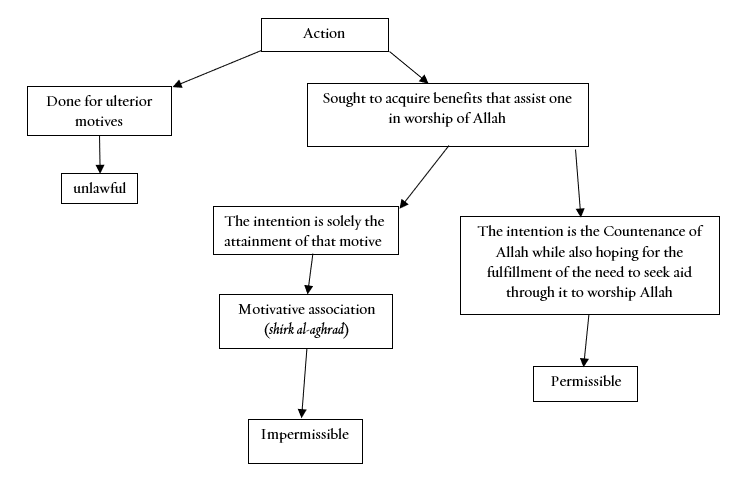
As for the invocations of remembrance (adkhar) and acts of worship that are done for the sake of expanding [one’s] provision, averting harms, destroying an oppressor, staving off poverty, fulfilling needs, and the like, if they are sought after in and of themselves[1] by means of that invocation or act of worship, it is considered a form of motivative association (shirk al-aghrad),[2] which is unlawful by consensus. If they are sought in order to assist one in worship of Allah (Exalted and Sublime is He), then the matter is not free of one of two possibilities. Either the person’s intention in that specific invocation or act of worship is solely the attainment of that motive, such as expansion in provision and the like, and not the Countenance of Allah (Exalted and Sublime is He), in which case it is also motivative association (shirk al-aghrad) and unlawful, or his intention in that invocation or act of worship is the Countenance of Allah (Exalted and Sublime is He) while also hoping for the fulfillment of his need in order to seek aid through it in worshipping his Lord and supplicate after his worship of Allah for the fulfillment of his need, in which case it is permissible and there is no blame in it. However [in this latter case], one must believe that Allah is the True Doer by His own choice and that it is not by that invocation—rather, [Allah acts] in conjunction with the invocation, not by it. One must seek the Countenance of Allah (Exalted and Sublime is He) by means of invocation and believe that the invocations and acts of worship do not have independent efficacy, and that Allah confers their unique properties and various rewards in conjunction with them, for He is the True Doer by His own choice and not by an external cause (‘illa). This is the standard by which such actions are deemed sound, and all of this is supported by transmitted proofs. And it is Allah who grants enabling grace![3]
[1] Meaning, the only reason a person invokes or does the act of worship is to obtain those benefits.
[2] Imam al-Sanusi listed “motivative association,” or shirk al-aghrad, as one of the six types of association (shirk). In his commentary on his al-Muqaddimat (The Prolegomena to Islamic Theology), he said:
As for motivative association (shirk al-aghrad), it is to act upon a divine command—be it obligatory or recommended, or to leave what is unlawful or disliked—but not for the sake of fulfilling the command of Allah (Blessed and Exalted is He), but rather for garnering praise from some of His servants by which he attains prestige in their eyes, or for obtaining wealth from them, or to deflect blame which he fears may come from them. Other motives would include obtaining the heavenly maidens (hur), palaces, the pleasures of Paradise, as well as safety from the Hellfire.
The reason for them doing this is their heedlessness of the Oneness of Allah. As such, the one doing these acts for ulterior motives falsely believes that it is possible to acquire benefit from other than Allah or have harm averted by other than Allah. He falsely believes that creation can benefit and harm, and therefore he is mindful of them when performing devotional acts. He also falsely believes that his devotional acts are independently capable of attracting good or averting harm in this life or the Next and therefore makes his devotional acts a cause for such things. If only it were to occur to him that Allah (Exalted and Sublime is He) alone is uniquely capable of creating everything in the cosmos without intermediary and that nothing besides Him has any [independent] effect—and included among “besides Him” are devotional acts—he would not have intended in his devotional acts (if given enabling grace for them) anything but the fulfillment of Allah’s command (Blessed and Exalted is He). Thereafter, he would desire what Allah (Exalted and Sublime) has promised him of the goodness paired with those devotional acts, understanding that it is without compulsion or entitlement. When we say “actions” here, we mean actions that are sought after in the revealed law, for it is in such action that ostentation (riya’) is forbidden. And with Allah is all success! (Shaykh Muhammad al-Sanusi, Commentary on The Prolegomena to Islamic Theology)
As for the ruling on motivative association, Imam al-Sanusi stated, “[I]t is disobedience by consensus but does not constitute disbelief (kufr).”
[3] Shaykh ‘Ali Harazim (quoting Shaykh Ahmad al-Tijani), Jawahir al-Ma‘ani, 2:709–710.

 Tijaniyat
Leave a comment